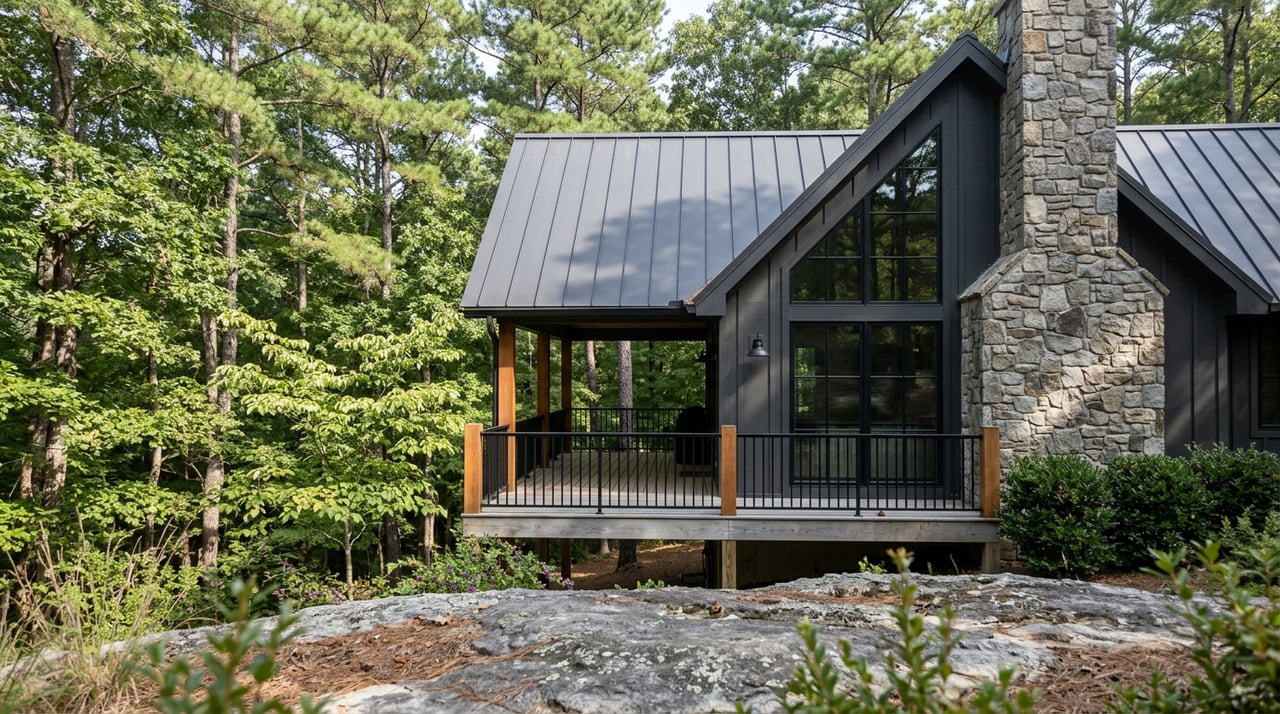
Somewhere in McCurtain County, two cabins sit within a mile of each other. Same metal roof, same hot tub on the back deck, same three-hour drive from Dallas. To a booking platform, to most buyers scrolling listings, they look interchangeable. They are not. One owes its lodging tax to the Town of Hochatown. The other owes it to the City of Broken Bow. And as of this past July, one of them had apparently been paying the wrong government, because Airbnb sorts cabins in this market by ZIP code, and Hochatown does not have one of its own.
That is not a rounding error. It is the subject of an actual lawsuit filed in McCurtain County District Court, where the Town of Hochatown is suing Airbnb, the Oklahoma Tax Commission, and the City of Broken Bow over lodging tax revenue the town says it never received.
If you are shopping for a cabin here as an income property, this is not a curiosity to skim past. It is a preview of the exact question you need to answer before you run a single cap rate: which government actually has authority over the parcel you are buying, and does the listing address tell you the truth about it?
Three governments in a few square miles
The cabin country around Beavers Bend State Park sits under three separate regulatory regimes, often within sight of one another. There is the City of Broken Bow. There is the Town of Hochatown, which incorporated in 2022 after residents voted 129 to 18, specifically so the town could regulate and tax the cabin boom building up around the lake. And there is unincorporated McCurtain County, which covers the land outside both town lines and, as of this writing, has no short-term rental ordinance at all.
Each of the three treats a cabin differently. Broken Bow's city code, under Ordinance No. 428, adopted in February 2024, confines short-term rentals to two zoning categories: C-5 Highway Commercial and the Commercial Recreation District, with a narrow grandfathering allowance for properties that were already operating as hotels or motels. Hochatown requires its own short-term rental license and monthly lodging tax remittance, a process the town moved to a new vendor called Granicus in October 2024 to make less painful for operators. Unincorporated county land requires neither.
None of that is visible from a listing photo. All three jurisdictions sit close enough together that the same road can cross from one to the next without a sign to mark it.
Why a flooded town doesn't have its own ZIP code
Here is the detail that makes the lawsuit make sense. The original Hochatown existed along the Mountain Fork River and had its own post office from 1894 into the 1960s, when the Army Corps of Engineers dammed the river to create Broken Bow Lake and the old townsite went under roughly 200 feet of water. The town that carries the Hochatown name today grew back up a few miles away, along Highway 259, but it never got its own ZIP code back. Cabins there still carry a Broken Bow mailing address.
Airbnb, according to the lawsuit, uses ZIP codes to decide which municipality gets paid. Since Hochatown addresses read as Broken Bow, the town says a chunk of its lodging tax revenue has been landing in the wrong account. Hochatown estimates lodging taxes account for roughly $4.3 million of its annual revenue, close to half the town's total budget, and says the misdirected share is real but still unknown.
The fix has been sitting in Congress. Senator James Lankford introduced a measure to create a dedicated ZIP code for Hochatown, and former Senator Markwayne Mullin co-sponsored a companion bill covering 69 communities nationwide with the same problem. Both stalled without a vote. Part of the holdup: U.S. Postmaster General David Steiner has estimated that creating new ZIP codes for all 69 communities would cost the Postal Service around $800 million. So the address confusion persists, the lawsuit is pending in McCurtain County District Court, and cabins keep changing hands in the meantime without anyone updating the mailing system underneath them.
What each jurisdiction actually requires
| Broken Bow (city) | Hochatown (town) | Unincorporated McCurtain County | |
|---|---|---|---|
| STR license required | No dedicated STR license, but zoning restricts where rentals are legal | Yes, plus monthly lodging tax remittance through Granicus | No formal ordinance as of this writing |
| Zoning restriction | Only in C-5 Highway Commercial and Commercial Recreation District, per Ordinance 428 | Governed by town code, not tied to Broken Bow's zoning map | None specific to short-term rentals |
| Who collects lodging tax | City of Broken Bow | Town of Hochatown | McCurtain County |
| Registration everyone needs regardless | Oklahoma Tax Commission sales tax permit | Oklahoma Tax Commission sales tax permit | Oklahoma Tax Commission sales tax permit |
That last row matters no matter which box your future cabin falls into. Every operator in the state, regardless of jurisdiction, has to register with the Oklahoma Tax Commission for sales tax collection. Oklahoma has no statewide short-term rental license and no statewide lodging tax, so everything above the 4.5 percent state sales tax is stacked on locally, city by city and county by county.
The tax math nobody agrees on
Here is where I want to be straight with you rather than hand you a clean number that might not survive contact with your closing statement. The two most detailed breakdowns I found of the combined tax burden on a Broken Bow-area cabin do not match.
One puts the total tax load inside Hochatown town limits at 16.25 percent, built from the 4.5 percent state sales tax, a 1.75 percent county sales tax, a 3 percent county lodging tax, and a 4 percent Hochatown town lodging tax, with unincorporated county properties landing at 9.25 percent since the town-level layer doesn't apply. Another source describes Hochatown's lodging tax alone at 14 percent against roughly 7 percent in the broader Broken Bow area, with a combined effective rate inside Broken Bow city limits closer to 7 to 10 percent.
Those are not small differences, and they are not reconcilable from where I sit. What that tells you is not that one guide is right and the other wrong. It is that the actual rate on the specific parcel you are considering needs to come from the town clerk, the county treasurer, or the Oklahoma Tax Commission directly, not from a blog post, before you plug a number into your underwriting. That includes this one.
Before you make an offer, verify these three things
- Confirm the parcel's actual jurisdiction, not its mailing address. A Broken Bow ZIP code does not mean Broken Bow city limits. Ask the seller's agent or check with the county assessor which government the parcel sits under.
- Ask whether an STR license already exists on the property, and if so, under which jurisdiction it was issued. If the cabin is inside Broken Bow city limits but outside the C-5 or Commercial Recreation zones, confirm how it is currently permitted to operate as a rental at all.
- Get the current combined tax rate in writing from the town or county office that actually collects it, not from an aggregator site. Given the live dispute over where this money is even supposed to go, a written confirmation protects you if the rules shift again.
A market still catching up to its own growth
None of this is happening in a vacuum. The Broken Bow and Hochatown cabin market grew from roughly 400 listed rentals before the pandemic to more than 2,400 by late 2023, a pace of growth that outran the towns' ability to build the tax and licensing infrastructure to match it. As of early July 2026, the broader McCurtain County market carried around 450 active listings with a median list price near $675,000, and homes were sitting closer to 101 days before selling, noticeably slower than the roughly 53-day national median reported around the same time. That is a market where buyers have room to be patient and ask the jurisdiction question before making an offer, rather than after.
FAQ
Does the ZIP code on a listing tell me which town or county actually governs it? No, and that is the entire point of the current lawsuit. Hochatown addresses carry a Broken Bow ZIP code because the original townsite flooded in the 1960s and the replacement town never received its own postal designation. Confirm jurisdiction through the county assessor or the relevant town office, not the mailing address.
If I buy in unincorporated McCurtain County, am I free of STR rules entirely? As of this writing, unincorporated county land has no formal short-term rental ordinance. That has been true for a while, but local government attention to the cabin boom has been increasing, not decreasing, so I would not treat the absence of rules today as a permanent guarantee.
Will the lawsuit change what I owe in taxes? It is pending in McCurtain County District Court, and the outcome is not yet decided. Given that lodging taxes reportedly make up close to half of Hochatown's town budget, this is worth watching if you own or are considering a property inside town limits, since any resolution could affect how remittance is handled going forward.
A cabin here can be a genuinely good investment. It can also be a genuinely confusing one to underwrite if you are working from a listing address instead of an actual parcel record. I spend my time in exactly this stretch of McCurtain County, and I would rather walk you through which jurisdiction a specific property sits in before you make an offer than have you find out from a tax notice after closing. If you are comparing cabins in Broken Bow, Hochatown, or the surrounding county, Teresa Bartlett can help you sort out what you are actually buying. Let's Connect.
